This guide helps St. Clair County homeowners choose the best boiler brands for local installation and explains efficiency, sizing, installation, and maintenance so you can make a confident, cost-effective decision. You will learn how brand choice affects energy bills and reliability, which manufacturers are well-suited for Michigan winters, and how professional installers handle sizing, permits, testing, and warranty registration. The article covers AFUE ratings, a concrete example of annual savings from upgrading to a high-efficiency boiler, local incentives, and service considerations specific to St. Clair County. By the end, you’ll know which brands perform best in this climate, how to compare models by AFUE and warranty, and how to engage a qualified local contractor to complete a compliant installation.
Why Is Choosing the Right Boiler Brand Important for St. Clair County Homes?
Choosing the right boiler brand directly affects a homeowner’s operating costs, repair frequency, and long-term comfort, as different brands prioritize efficiency, durability, and local serviceability. Brands differ in heat-exchanger materials, modulating burner control, and warranty support, and those differences translate into varying AFUE ratings, maintenance intervals, and spare-parts availability. In St. Clair County, with its colder winters, reliability and cold-start performance matter as much as peak efficiency, and a well-chosen brand reduces the risk of mid-winter failures and costly emergency repairs. Understanding these brand-level trade-offs leads naturally to evaluating specific models, installation practices, and how local service networks influence real-world uptime and total cost of ownership.
How Do Boiler Brands Affect Energy Efficiency and Heating Costs?
Boiler brands influence energy efficiency through design choices, such as condensing heat exchangers, modulating burners, and control logic that optimize fuel use at partial load. AFUE (Annual Fuel Utilization Efficiency) quantifies seasonal efficiency; for example, an 80% AFUE unit sends 80% of the fuel energy into the home while losing 20% to exhaust and system losses, whereas a 95% AFUE condensing boiler captures additional latent heat and significantly reduces annual fuel use. This engineering difference matters because a boiler’s AFUE multiplies against a household’s annual heating load to determine fuel consumption and bills, so choosing a higher-AFUE brand can shorten payback when fuel prices are moderate to high. Brand-level differences also affect lifecycle maintenance costs, since some manufacturers use replaceable modular components while others employ long-lived cast-iron heat exchangers.
What Local Climate Factors Influence Boiler Performance in St. Clair County?
St. Clair County’s frequent low-temperature cycles increase runtime and stress on heat exchangers, so cold-start resilience and freeze protection are essential brand attributes to evaluate. Fuel type and local fuel pricing can make gas-fired condensing boilers attractive, but compatibility with existing hydronic distribution, domestic hot water needs, and whether a combi or system boiler is preferable depends on home size and occupant hot-water demand. Sizing and load calculation become critical in this climate, because an oversized boiler will cycle frequently and lose condensing efficiency, while an undersized unit won’t maintain comfort on the coldest nights. Considering these regional factors helps narrow the field to brands with proven low-temperature performance and robust service networks for timely repairs.
Which Are the Top Boiler Brands Recommended for Installation in St. Clair County?
Local installers and energy-conscious homeowners commonly recommend a short list of manufacturers that balance efficiency, reliability, parts availability, and local dealer support. The best brands for St. Clair County typically include established names known for condensing technology, compact combi options for smaller homes, and cast-iron models for durability in larger systems. Below are concise brand highlights you can use to match home size, fuel type, and maintenance preferences.
- Weil–McLain: Known for durable cast-iron and high-capacity boilers well-suited to larger homes and retrofit hydronic systems.
- Navien: Offers high-AFUE condensing units and compact combi boilers that save space and deliver efficient domestic hot water.
- Bryant: Provides reliable mid- to high-efficiency models with straightforward warranty support and dealer-backed service options.
This short list focuses on brands that combine field-proven reliability with serviceable parts and warranty coverage, especially relevant for homeowners in colder climates.
Weil-McLain: What Are the Key Features of Weil-McLain Boilers for Local Homes?
Weil–McLain boilers are recognized for their durability and for a product line that includes cast–iron sectional units and high-efficiency stainless-steel condensing models, making them adaptable to both large, older homes and modern systems. Their cast-iron heat exchangers provide long service life under heavy load, while their higher-capacity models reduce the need for multiple parallel units in large residences. Weil–McLain’s parts network and familiarity among local technicians make repairs and maintenance more straightforward in areas with established HVAC trade activity. These attributes make Weil–McLain a strong option when long-term reliability and serviceability are top priorities.
Navien: How Do Navien Boilers Combine High Efficiency and Smart Technology?
Navien focuses on condensing technology with stainless-steel heat exchangers, modulating burners, and integrated controls that maximize thermal capture and adjust output to load, improving seasonal AFUE. Their combi boilers pair space heating and domestic hot water in a compact footprint, which is useful for homes with limited mechanical room space or where replacing a separate water heater is desirable. Smart control features and efficient modulation reduce standby losses and throttle fuel consumption during mild weather, translating to lower operating costs in moderate-to-cold climates. For homeowners prioritizing top-tier efficiency and compact installation, Navien’s product line is compelling.
Bryant: What Makes Bryant Boilers a Reliable Choice for St. Clair County Residents?
Bryant offers a range of mid- to high-efficiency boilers that integrate well with common HVAC controls and thermostats, making retrofit installations less invasive in homes that already use Bryant equipment. Their models deliver competitive AFUE ratings and are supported by a dealer network that handles warranty service and parts, which simplifies long-term ownership. Bryant’s product positioning emphasizes reliable performance and accessible service rather than niche top-end features, making it a solid choice for homeowners seeking balanced value and dependable local support. Local dealers’ ability to coordinate warranty registration and routine maintenance contributes to a smoother ownership experience.
The table below summarizes representative brand/model attributes to help scan efficiency, fuel type, and warranty features for local suitability.
| Brand & Model Example | Typical AFUE / Efficiency | Fuel Type | Warranty Highlight |
|---|---|---|---|
| Weil–McLain cast–iron model | 80–85% AFUE | Natural Gas / Oil | Long-life heat exchanger coverage |
| Navien condensing combi | 95%+ AFUE | Natural Gas | 5–10 year heat exchanger coverage |
| Bryant mid/high-efficiency model | 85–95% AFUE | Natural Gas | Dealer-handled warranty support |
This table highlights core trade-offs: cast-iron units favor durability, condensing units favor efficiency, and dealer-backed brands simplify warranty handling locally. Use these attributes to prioritize brand selection based on home size, fuel type, and service preferences.
How Do Certified Technicians Ensure Code Compliance and Customer Satisfaction?
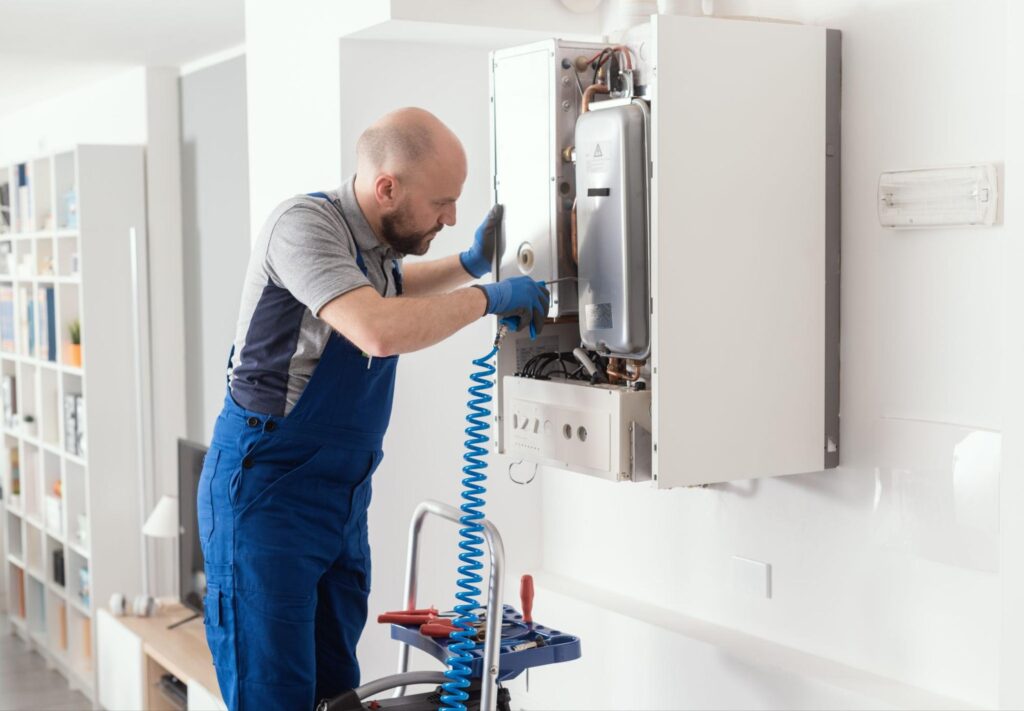
Certified technicians ensure compliance by following local mechanical and fuel-gas codes, securing required permits, completing mandated safety checks, and documenting commissioning tests to verify safe operation. They use calibrated instruments to test combustion and venting, verify pressure and leak-free connections, and implement recommended piping practices such as proper pump selection, expansion tank sizing, and corrosion control. Clear communication and a final homeowner walkthrough, explaining controls, warranty terms, and maintenance intervals, are key steps to improve customer satisfaction and reduce post-installation service calls. This combination of technical diligence and transparent communication supports long-term system performance and homeowner confidence.
How Can Homeowners Understand Boiler Efficiency Ratings and Cost Savings?
Understanding boiler efficiency and cost implications starts with AFUE, which expresses how much of the fuel’s energy is turned into useful heat over a typical heating season, and then applying that rate to your home’s annual heating load to estimate fuel use and cost. Comparing an older non-condensing boiler to a modern condensing model illustrates real savings: higher AFUE reduces annual fuel consumption and often shortens payback when fuel prices or incentives favor efficiency upgrades. Homeowners should evaluate payback by estimating current annual fuel costs, applying projected percentage fuel savings from AFUE improvements, and factoring in installation costs minus rebates or financing. Grasping these elements guides whether a replacement makes financial and comfort sense in the near term.
What Does AFUE Rating Mean and Why Is It Important?
AFUE stands for Annual Fuel Utilization Efficiency and measures the percentage of fuel converted to heat in a typical heating season; higher percentages indicate less waste through flue gases and standby losses. The practical implication is straightforward: a 95% AFUE condensing boiler converts 95% of fuel energy into heat, whereas an 80% AFUE non-condensing unit wastes one-fifth of fuel energy to exhaust—an essential consideration for households with high annual heating loads. AFUE is used to compare technologies (condensing vs. non-condensing) and to inform payback calculations, because a higher AFUE directly reduces annual fuel consumption for the same heating demand. Understanding AFUE helps homeowners prioritize features like modulation and condensing heat exchangers when evaluating brand and model choices.
The table below compares an older 80% AFUE boiler to a modern 95% AFUE model, using representative heating load and fuel cost assumptions to illustrate typical annual savings.
| Old Boiler vs New Model | Estimated Annual Fuel Use (Therms) | AFUE | Estimated Annual Fuel Cost |
|---|---|---|---|
| Old 80% Boiler | 2,000 therms | 80% | $2,400 |
| New 95% Condensing Boiler | 1,684 therms | 95% | $2,020 |
| Estimated Annual Savings | 316 therms | — | $380 |
This example shows how AFUE improvements translate into quantifiable annual savings based on assumed heating load and fuel cost; actual savings will vary by home and fuel prices.
How Much Can You Save Annually with a High-Efficiency Boiler?
Savings depend on current system efficiency, local fuel prices, and your home’s annual heating load, but upgrading from an 80% AFUE unit to a 95% AFUE condensing boiler typically yields savings in the range of 10–25% annually. Using the earlier example, that difference produced roughly $380 in annual fuel savings at the assumed rates; over time, those annual savings compound and contribute to the payback of installation costs. Payback periods commonly range from a few years to a decade, depending on installation costs, available incentives, and fuel price volatility, so homeowners should compute a simple net present value or payback calculation for decision-making. A local contractor can run these numbers using your historical fuel bills and proposed model specifics to generate realistic expectations.
What Local Incentives or Rebates Are Available for Energy-Efficient Boilers?
Local and state incentives, utility rebates, and occasional federal programs can materially reduce the upfront cost of high-efficiency boilers, but program availability and eligibility often change, so checking current local utility and state energy program resources is essential. Incentives may target condensing boilers, energy-efficient combi units, or whole-home upgrades, and many programs require equipment and installer certifications to qualify. Incentives influence net cost and payback, so homeowners should include potential rebates when comparing replacement options and financing scenarios.
When Should You Consider Boiler Repair or Maintenance in St. Clair County?
Homeowners should consider repair when operational performance declines, manifested as uneven heat, frequent cycling, increased fuel bills, strange noises, or visible leaks, because early diagnosis prevents more costly failures and protects occupants from safety risks. Regular preventive maintenance preserves efficiency, extends equipment life, and reduces emergency service calls by addressing scale buildup, corrosion, burner tuning, and control calibration on a schedule. In a cold climate like St. Clair County, pre-season maintenance before winter and post-season checks can identify issues such as low pressure, failing pumps, or compromised venting before they cause a loss of heat during cold snaps. Knowing when to call a qualified technician saves money and minimizes disruption to home comfort.
What Are Common Signs That Your Boiler Needs Repair?
Recognizing warning signs early helps avoid breakdowns: common indicators include loss of heating output, fluctuating or high fuel bills, unusual banging or hissing noises, visible water leaks, or repeated low-pressure conditions that require topping off. Some symptoms are time-sensitive—water leaks and pressure loss can lead to system damage quickly and should prompt immediate service, while gradual efficiency loss may be addressed during scheduled maintenance. Safety-first actions include shutting off the fuel and calling a qualified technician if there is a smell of gas or signs of combustion issues; non-urgent signs, like reduced hot-water capacity, can be scheduled for inspection. Early intervention typically reduces repair complexity and cost compared to waiting for catastrophic failure.
How Does Regular Maintenance Extend Boiler Lifespan and Efficiency?
Regular maintenance, annual inspections, burner tuning, heat-exchanger cleaning, water treatment, and control calibration preserve AFUE by preventing soot buildup, corrosion, and pump failures that reduce heat transfer efficiency. A routine maintenance schedule identifies small leaks, worn valves, and failing sensors early, thereby extending component life and preventing secondary damage to radiators, piping, or the boiler’s heat exchanger. Maintenance also ensures safety devices function correctly and that the system operates within manufacturer-recommended parameters for warranty compliance. Over the long term, disciplined maintenance can add years to service life and help maintain efficiency levels that support predictable operating costs.
Below is a concise checklist homeowners can use to prepare for a service visit and ensure routine tasks are consistently performed.
- Annual burner and control inspection to verify safe combustion and proper sequencing.
- Heat-exchanger inspection and cleaning to maintain efficient heat transfer.
- Pump, expansion tank, and pressure-relief valve checks to prevent leaks and pressure problems.
- Water treatment and system flushing, where applicable, to control scale and corrosion.
Regular execution of these tasks minimizes wear, keeps the system operating near its rated efficiency, reduces the likelihood of mid-winter emergencies, and preserves warranty conditions.
Call Us When You Want Boiler Brands That Actually Last

Choosing the right boiler for your St. Clair County home is more than just comparing labels. At S&P Heating, we work with trusted boiler brands to deliver long-lasting warmth backed by solid warranties and expert HVAC installation. Our comfort specialists help you choose the perfect match based on your home’s layout, heating demands, and budget.
Skip the guesswork and let us walk you through it. Contact S&P Heating today to learn which high-efficiency boiler is best for your home and start planning your installation!
FAQ: Choosing the Right Boiler Brand
Do different brands offer better energy efficiency?
Absolutely. Some brands specialize in high-efficiency, Energy Star-rated systems that help you lower your utility bills and reduce your carbon footprint.
Are warranties different by brand?
Yes. Some offer 10-year warranties, while others offer only 5-year warranties. We’ll break it down so you can choose with confidence.
Keep Your System Running Strong—Read Our Boiler Upkeep Tips
Now that you’ve picked your brand, make sure it lasts. Check out: Essential Boiler Upkeep Tips for St. Clair County Residents: Expert Maintenance and Safety Advice